23/11/2026, 10:20:04 am
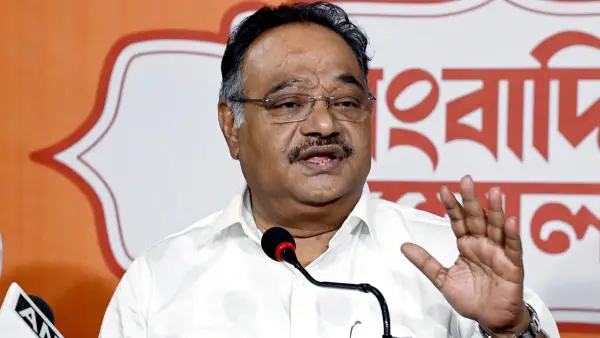
West Bengal BJP chief Samik Bhattacharya urges protest against attacks on Hindus in
Bhattacharya, also a BJP Rajya Sabha MP, underscored India's historical role in Bangladesh's creation, but argued that the founding of Bangladesh was premised more on religious difference than on linguistic unity. "Bangladesh was not created for the sake of language. If it had been, Bengali-speaking Hindus in Bangladesh would not be dying like this today," he remarked. According to Bhattacharya, the foundational mistake was neglecting protection for minorities and failing to establish a truly democratic environment. He criticized what he characterized as the leadership's surrender to religious fundamentalism during the birth of Bangladesh.
The BJP leader connected these contemporary incidents to the broader historical ramifications of Partition, maintaining that the lingering wounds continue to trouble the region. He claimed that religious minorities, particularly Hindus in Bangladesh, remain disproportionately affected. Bhattacharya went on to attribute blame for Partition to Jawaharlal Nehru and Mahatma Gandhi, stating that if Netaji Subhas Chandra Bose had become India's first Prime Minister, he would have rejected the two-nation theory and prevented the division of the subcontinent into India, Pakistan, and later Bangladesh.
Bhattacharya's remarks come amid new political tensions in Bangladesh, where efforts at stabilizing bilateral relations with India have encountered difficulties. These tensions have been exacerbated by the presence of former Bangladesh Prime Minister Sheikh Hasina in India since August 5, 2024, after she sought refuge across the border. Hasina has since expressed her intent to return to Bangladesh, but her situation remains unresolved.
Relations between India and Bangladesh have come under scrutiny in recent months as these shifts have cast uncertainty over the regional political landscape. Bhattacharya's comments reflect growing unease in West Bengal about the ongoing security and status of Bengali Hindus in Bangladesh, at a time when diplomatic ties and domestic political scenarios in both countries remain volatile.
More Flips

Get real-time finance, business & capital market news in 50 words and get recommendations from top brokers delivered to your phone.


All Rights Reserved. Entroq Technologies Private Limited © 2022-2026