10/10/2026, 1:19:03 pm
SpaceX Crew-12 Astronauts Return to Earth After 237 Days in Space
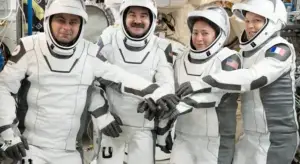
Crew-12 comprised NASA astronauts Jessica Meir and Jack Hathaway, European Space Agency (ESA) astronaut Sophie Adenot, and Roscosmos cosmonaut Andrey Fedyaev. The mission launched from Earth on February 13, 2026, and docked with the ISS the following day. Both Meir and Fedyaev were returning crew members with previous spaceflight experience, while Hathaway and Adenot embarked on their inaugural missions to space.
The International Space Station serves as a continuously staffed research laboratory in low Earth orbit. During their nearly eight months aboard the station, Crew-12 conducted a series of scientific investigations focused on human health and technologies for future space exploration. Key projects included the production of stem cells in microgravity, advancements in the technology required to manufacture intravenous fluids on demand, and research into the mechanisms by which pneumonia-causing bacteria might contribute to heart damage. Additional experiments explored nutrition and factors influencing blood flow in the unique environment of spaceflight.
The ability to produce on-demand IV fluids is considered a potentially critical capability for future extended missions, especially to destinations such as the Moon or Mars where resupply options are limited. Research into the health impacts of long-duration space missions is essential for planning future expeditions and ensuring astronaut safety on deep-space journeys.
A significant aspect of Crew-12’s time aboard the ISS involved extravehicular activity, commonly known as spacewalks. Jessica Meir completed four spacewalks during this mission, raising her career total to seven and placing her third in NASA’s all-time ranking among female astronauts, behind only Peggy Whitson and Suni Williams. Sophie Adenot conducted three spacewalks, marking a milestone as the first French woman to perform an EVA outside the ISS.
Following the capsule’s splashdown, SpaceX recovery teams swiftly retrieved the spacecraft and its occupants. Once back on board the recovery vessel, the astronauts underwent standard medical evaluations before their return to NASA’s Johnson Space Center in Houston, Texas.
The data and advancements generated by Crew-12 are expected to contribute significantly to the understanding of human health in space and assist ongoing preparations for future missions beyond low Earth orbit.
More Flips

Get real-time finance, business & capital market news in 50 words and get recommendations from top brokers delivered to your phone.


All Rights Reserved. Entroq Technologies Private Limited © 2022-2026