19/9/2026, 5:20:03 pm
MIT robot assembles laser cavity in 50 steps, self-corrects after disruption
Precision alignment of optical equipment such as lasers, mirrors, and lenses has traditionally been a labor-intensive process, with even minute misalignments significantly impacting experimental outcomes. MIT’s system aims to automate these tasks from initializing randomly positioned components to achieving full alignment, fine-tuning, and even maintaining the experiment in the face of subtle disruptions. The robotic platform is able to dismantle one optical configuration and build another, promising a significant reduction in the time and skill traditionally required for such setups.
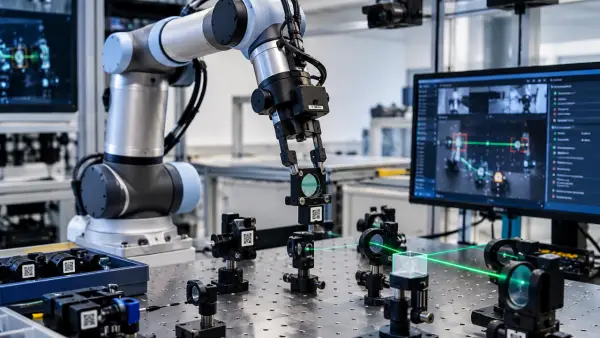
Central to the new laboratory is a seven-jointed robotic arm operating on a metallic tabletop. Optical components, each held in custom 3D-printed housings with QR codes describing their identities and specifications, are picked up and positioned by the robot. Magnetic bases ensure stable placement, while a wireless fine-adjustment tool allows the robot to precisely control the angle and position of mirrors, performing delicate tasks normally handled by experienced researchers. Overhead cameras give a bird’s-eye view of the setup, and custom software orchestrates the process, ensuring collision avoidance and stepwise execution.
The team, led by Sachin Vaidya, a postdoctoral researcher at MIT’s Research Laboratory of Electronics, selected the assembly of a laser cavity - a test requiring substantial optical alignment - as the ultimate demonstration. The robot began with unassembled components, arranged them into the correct configuration, and fine-tuned the setup until a working laser cavity was achieved. In a subsequent test, researchers deliberately disturbed the apparatus by moving a component. The robot autonomously detected the misalignment and made the necessary adjustments, restoring the laser’s intensity without human intervention.
This capacity for self-correction could have significant implications for experimental reliability. According to the research team, optical experiments are often hampered by environmental changes such as vibration or temperature shifts that can degrade results over time. With an autonomous system continuously monitoring and realigning experiments, valuable data integrity could be preserved.
Looking ahead, the MIT group envisions the technology as part of a broader ecosystem of automated research. Efforts are underway to develop cloud-based applications that would enable remote researchers to submit protocols online and have robotic laboratories carry out the physical assembly and operation. Such systems could operate continuously and repetitively, performing tasks without fatigue, while freeing scientists to focus on higher-level analysis and innovation.
While currently a research demonstration, MIT’s success in automating the assembly and maintenance of delicate optical experiments points toward a future where experimental laboratories rely increasingly on robotic precision and resilience. The team also foresees applications beyond lasers, such as in testing cameras, displays, solar cells, or augmented reality devices and in accelerating fundamental research areas like carbon-capture materials. For now, the 50-manoeuvre laser experiment marks a milestone in automating one of science’s most exacting technical disciplines.
More Flips

Get real-time finance, business & capital market news in 50 words and get recommendations from top brokers delivered to your phone.


All Rights Reserved. Entroq Technologies Private Limited © 2022-2026