24/11/2026, 5:16:02 pm
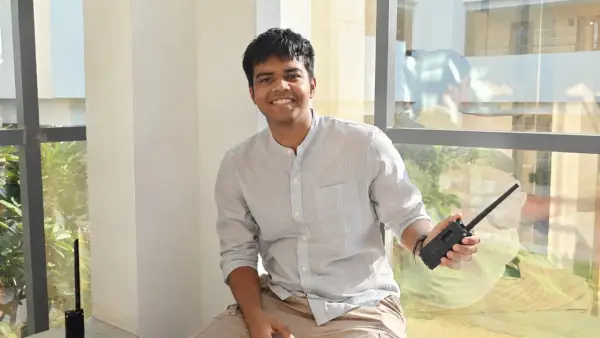
Hyderabad student, 20, develops towerless, SIM-free radio for the Army
While exploring communications for drones, Srivastava realized a deeper issue facing the Indian Armed Forces: the difficulty soldiers have maintaining reliable communications in areas lacking conventional infrastructure. Conversations with military personnel convinced him of the urgency of this problem, prompting him to leave Apollyon Dynamics in April 2026 and launch Krathveil Private Limited the following month.
Initially working solo, Srivastava was later joined by batchmate Shresth Prakash Singh as co-founder, along with Darshan Bhandari and Sarika Revitsar, all pursuing their third year at BITS Hyderabad. Most of the development for their debut product, Krath Control, has occurred in their hostel rooms. Designed as a lightweight, pocket-sized radio, Krath Control pairs with soldiers’ smartphones to form an encrypted mesh network. Unlike traditional walkie-talkies dependent on towers or satellites, these devices communicate directly, enabling voice, data, and location sharing via robust, self-healing networks that endure even if individual units drop out. Srivastava estimates that a single connection between two hilltops could extend coverage to more than 100 kilometers, though field-testing will determine the exact operational range.
A major priority for Krathveil is cost. While similar imported systems can cost upwards of Rs 2 lakh per unit, the startup is targeting a price point between Rs 40,000 and Rs 50,000, leveraging open-source technologies and existing research to keep expenses low. The prototype was built for between Rs 25,000 and Rs 35,000. Early funding came from Srivastava’s savings, help from friends, and support from his parents, allowing the team to assemble four working prototypes, including a drone-mountable relay.
Krathveil’s technology has already attracted attention from the Indian Army, with prototypes demonstrated to two army units and the Army Defence College. Srivastava reported that feedback was positive, with the technology being recognized as a first of its kind from an Indian startup, though the devices are still subject to formal certification and refinement. The Army requested enhancements such as increasing the radio’s output power to 1 watt and improving antennas, which Krathveil is addressing ahead of seeking further assessments.
Despite the demands of building a DPIIT-recognized defence technology venture, Srivastava continues to juggle an intensive academic load, often working 12 to 16 hours on demonstration days. The startup’s immediate goal is to evolve Krath Control from prototype to a field-ready product. Looking ahead, Srivastava envisions Krathveil as a foundation for resilient, indigenous communication and intelligence networks supporting India’s armed forces over the next decade.
More Flips

Get real-time finance, business & capital market news in 50 words and get recommendations from top brokers delivered to your phone.


All Rights Reserved. Entroq Technologies Private Limited © 2022-2026