28/11/2026, 3:17:02 am
Eagle talon punctures found on three of five adult baboon skulls in Chad
The research, led by Catherine Hobaiter and an international team from the University of St Andrews, African Parks, the Max Planck Institute of Animal Behavior, the University of Konstanz, Dartmouth College, and others, focused on the Ennedi Natural and Cultural Reserve. The team retrieved baboon bones from sandstone cliffs and rocky deposits, including skulls and a shoulder blade showing deep punctures and scraping marks close to the eye sockets and scapula. Such injuries closely resemble those previously documented on primate remains found beneath eagle nests.
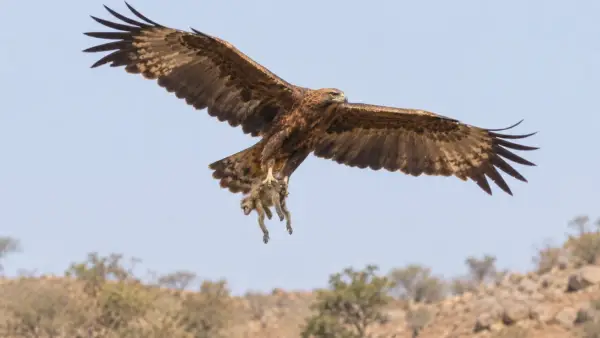
Fieldwork conducted in June 2026 added further significance when the team recovered the skull and partial skeleton of an adult male baboon estimated to weigh over 26 kilograms, also bearing signs of significant puncture wounds. In total, eight adult males with an average weight of 22.2 kilograms were studied, with the injuries suggesting a pattern consistent with talon strikes from large eagles such as Verreaux's eagle (Aquila verreauxii), which inhabits the surrounding region. These raptors are generally known to prey on smaller mammals like the rock hyrax, but are also capable of tackling larger animals under certain conditions.
The researchers explored alternative explanations for the wounds, including gunshots, intraspecific fights among baboons, or post-mortem scavenging. However, the nature and location of the puncture marks, coupled with the absence of typical tooth or gunshot damage, led the team to consider eagle predation as the most plausible cause. While it remains unclear whether the birds hunted the baboons or scavenged their remains, the depth and severity of the wounds strongly suggest predator-prey interaction.
Traditionally, primates weighing more than 13 kilograms have been considered outside the range of avian predators. This new evidence from Chad extends that limit, raising questions about the risks even large adult primates have historically faced from above. The findings also shed light on how the unique landscape of Ennedi, with its steep cliffs and rocky formations, may provide protection from ground predators but expose baboons to ambushes from the sky.
Beyond its implications for understanding predator-prey relationships in today’s ecosystems, the research offers insights into the evolutionary pressures that could have shaped the behavior and physiology of primates, including early humans. Encounters with large predatory birds may have influenced where primates chose to rest, feed, and travel, as well as the development of group vigilance and other defensive behaviors. As the conversation around human evolution continues, the study from the cliffs of Chad underscores the complex array of threats our primate ancestors faced - not just on the ground, but from the skies as well.
More Flips

Get real-time finance, business & capital market news in 50 words and get recommendations from top brokers delivered to your phone.


All Rights Reserved. Entroq Technologies Private Limited © 2022-2026