7/11/2026, 5:16:02 pm
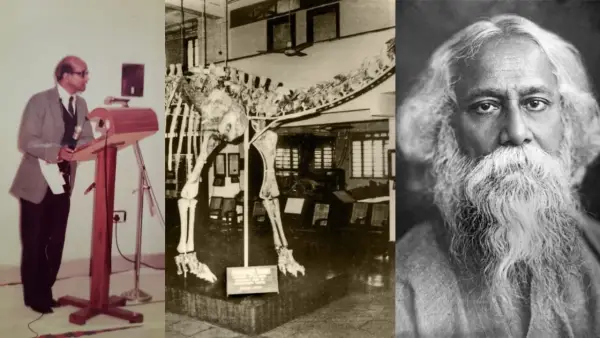
Both Tagore and the paleontologist who found it have dinosaurs named after them
The story began in 1958, when geologists uncovered dinosaur bones near Pochampalli in Maharashtra’s Gadchiroli district, close to the Telangana border. This discovery prompted a full-scale excavation campaign in the subsequent years, led jointly by the Geological Studies Unit of the Indian Statistical Institute, Calcutta and researchers from University College London. The team, which notably included British paleontologist Pamela Lamplugh Robinson and a young Indian researcher, Sohan Lal Jain, focused their efforts on a single fossil deposit in the Lower Jurassic Kota Formation.
Recovering nearly 300 bones representing at least six individual sauropods, the researchers identified the fossils as belonging to massive, plant-eating dinosaurs that roamed the region nearly 190 million years ago. Strikingly, the assemblage included a thigh bone measuring approximately 1.7 metres in length, prompting the expedition’s leaders to propose the genus name Barapasaurus, meaning “big-legged lizard.” In deference to the ongoing celebrations for Tagore, the species was formally named Barapasaurus tagorei, an honor approved by the Indian Statistical Institute’s Scientific Council in 1961.
The finds would help cement Barapasaurus as one of the best-documented early sauropods, with an estimated length between twelve and fourteen metres. Today, a mounted skeleton of Barapasaurus tagorei is housed in the Geological Museum of the Indian Statistical Institute in Kolkata, serving as a tangible reminder of this unique intersection of cultural and scientific heritage.
The scientific work arising from this expedition proved equally enduring for Sohan Lal Jain, who dedicated 33 years to the study of India’s fossil vertebrates, particularly its sauropod dinosaurs. Jain’s research included an influential study of a sauropod braincase from the Lameta Formation near Jabalpur, which contributed to the evolving classification of these prehistoric giants. In recognition of his achievements, paleontologists Adrian Hunt, Martin Lockley, Spencer Lucas, and Christian Meyer, in 1995, established the genus Jainosaurus, reclassifying material previously attributed to Antarctosaurus septentrionalis.
Further extending his legacy, Jain, together with Saswati Bandyopadhyay, described another significant sauropod specimen from Central India’s Late Cretaceous deposits. This discovery, initially named Titanosaurus colberti in honor of American paleontologist Edwin H. Colbert, would later become the genus Isisaurus after taxonomic revision by Jeffrey Wilson and Paul Upchurch in 2003. The new name paid tribute to the Indian Statistical Institute, which had played a central role in India’s paleontological research.
The saga of Barapasaurus tagorei and Jainosaurus illustrates more than just the story of bone discoveries. It highlights the meticulous and patient labor of paleontologists and the shifting nature of scientific understanding through comparison, description, and frequent re-evaluation. As scientific classifications continue to evolve, the names of these dinosaurs stand as a lasting record of the collective contributions of poets, scientists, and the institutions that have helped piece together India’s prehistoric narrative.
More Flips

Get real-time finance, business & capital market news in 50 words and get recommendations from top brokers delivered to your phone.


All Rights Reserved. Entroq Technologies Private Limited © 2022-2026